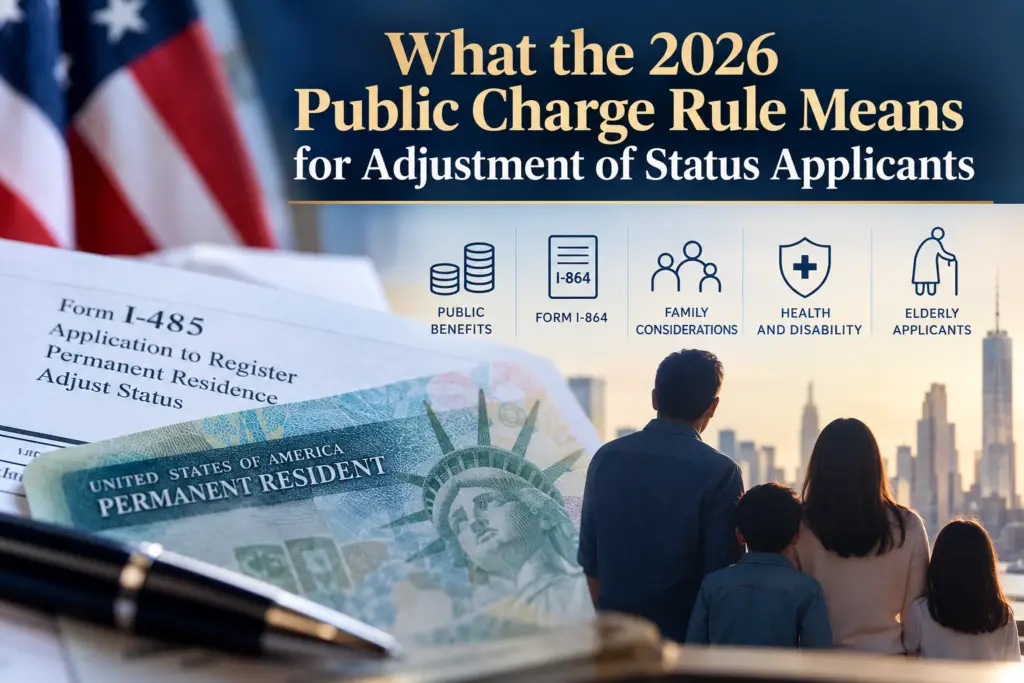
On September 18, 2026, a new federal public charge framework took effect for many applicants seeking adjustment of status to lawful permanent residence in the United States. The change gives USCIS officers broader discretion to consider an applicant’s financial circumstances, use of certain public benefits, household situation, health, education, employment history, and other factors when determining whether the applicant is “likely at any time to become a public charge.” DHS’s Final Rule rescinded much of the detailed 2022 regulatory framework and shifted significant portions of the adjudicatory methodology to USCIS guidance.
What Is the Public Charge Rule?
Section 212(a)(4) of the Immigration and Nationality Act provides that a person who, in the opinion of the immigration officer, is likely at any time to become a public charge may be inadmissible.
Congress requires officers to consider at least five factors:
- age;
- health;
- family status;
- assets, resources, and financial status; and
- education and skills.
Where required, a qualifying Form I-864, Affidavit of Support, is also relevant to the determination. The inquiry is prospective: USCIS is attempting to determine whether the applicant is likely to become a public charge in the future rather than simply asking whether the applicant has ever received assistance.
What Changed on September 18, 2026?
The most important structural change is that DHS did not replace the 2022 regulations with another detailed regulatory test. Instead, the Final Rule removed much of the 2022 regulatory framework and restored broader discretion to adjudicating officers, with USCIS supplying much of the operational framework through its Policy Manual and related guidance.
Under the 2022 framework, the inquiry centered principally on whether an applicant was likely to become primarily dependent on the government for subsistence, generally through public cash assistance for income maintenance or long-term institutionalization at government expense.
The 2026 framework permits USCIS to consider a broader universe of means-tested public benefits as part of the public charge analysis. The presentation emphasized that the analysis remains individualized and that the existence of a particular benefit does not, standing alone, necessarily determine the outcome.
USCIS may consider such matters as the nature of a benefit, the amount involved, how long and how recently it was received, why it was received, and whether the underlying circumstances continue. USCIS guidance also permits consideration of applications or approvals for certain benefits even where benefits ultimately were not received, insofar as USCIS views those facts as potentially relevant to future reliance.
Public Benefits Do Not Automatically Mean a Green Card Will Be Denied
One of the most important points for adjustment applicants is that the new rule should not be understood as creating a simple list of benefits that automatically results in denial.
The statutory inquiry remains based on the applicant’s circumstances as a whole. As discussed during the AABANY program, a person should therefore not discontinue benefits simply because of generalized concern about public charge without first determining whether the public charge ground applies, who is actually receiving the benefit, what program is involved, when the benefit was received, and what the applicant’s other circumstances show.
This distinction can be particularly important because many families include U.S. citizens, lawful permanent residents, or persons in immigration categories that are not themselves subject to the public charge ground.
The I-864 Is Important, But It May Not Be the End of the Analysis
For many family-sponsored immigrants, an adequate Form I-864, Affidavit of Support, remains a mandatory part of establishing admissibility.
A sufficient I-864 is therefore extremely important. Under the new framework, however, USCIS may continue beyond the affidavit and examine the applicant’s overall circumstances.
For that reason, applicants and counsel may need to consider whether the adjustment application should include evidence beyond the minimum forms. Depending on the facts of the case, relevant evidence could include:
- current employment and salary;
- tax returns and employment history;
- household income;
- bank, retirement, or investment assets;
- debts and liabilities;
- educational credentials;
- professional licenses and certifications;
- occupational skills;
- health insurance;
- evidence concerning significant medical expenses;
- benefit history; and
- evidence of available household or sponsor support.
The purpose is not necessarily to overwhelm USCIS with documents, but to present the applicant’s circumstances affirmatively where the facts warrant doing so. The AABANY presentation identified this as a significant practical change for attorneys preparing adjustment cases under the new framework.
Older and Retired Adjustment Applicants
The public charge analysis may require particular attention when the applicant is elderly or has already retired.
Age itself does not make a person inadmissible. Rather, age is one of the statutory factors, and retirement changes the type of evidence that may be important.
For a retired applicant, a strong record may focus less on current employment and more on sources such as:
- Social Security retirement benefits;
- pensions and annuities;
- retirement accounts;
- investment or rental income;
- savings;
- home ownership or home equity;
- limited debt;
- health insurance;
- household resources; and
- financial support available from family members or a sponsor.
USCIS guidance discussed during the presentation includes an example of a 65-year-old retired applicant with a pension, Social Security retirement and survivor benefits, limited retirement savings, a home owned outright, no significant identified medical condition, no history of means-tested benefits, and adequate support. USCIS considers the circumstances collectively rather than treating retirement itself as determinative.
For families sponsoring an older parent, this means planning for public charge should begin before filing. The relevant question is not simply whether the parent works, but what the parent’s overall financial, health, insurance, household, and support picture looks like.
Applicants With Disabilities or Significant Health Conditions
Health is expressly one of the five statutory factors USCIS must consider.
A disability therefore may be relevant where it affects a person’s ability to work, care for themselves, creates foreseeable medical expenses, or interacts with the applicant’s financial circumstances. At the same time, the existence of a disability alone does not resolve the public charge inquiry. USCIS must consider the individual’s circumstances as part of the broader analysis.
A careful filing may need to address issues such as:
- whether the applicant is able to work;
- prior employment history;
- income or resources independent of employment;
- health insurance coverage;
- how anticipated treatment or care will be paid for;
- family and household support;
- assets;
- the nature of any benefits received; and
- whether the circumstances resulting in benefit use are temporary or continuing.
This is an area where the exact benefit matters. Applicants should not assume that every government-related payment or disability benefit is treated the same way. The particular program, its eligibility requirements, the identity of the recipient, and the applicant’s other circumstances should be reviewed individually.
Mixed-Status Families and Benefits Received by Children
The new framework also creates difficult questions for mixed-status households—for example, where a parent is applying for permanent residence while one or more children are U.S. citizens.
A U.S.-citizen child’s receipt of a benefit should not simply be treated as though the immigrant parent personally received that benefit. Nevertheless, USCIS guidance permits consideration of household circumstances, and benefit use within the household may reveal information USCIS views as relevant to the applicant’s financial resources and support structure.
That distinction is important.
The appropriate analysis may include:
- Who is legally receiving the benefit?
- Is the recipient the adjustment applicant or another family member?
- Is the benefit means-tested?
- Does the benefit indicate anything about the applicant’s own income or household finances?
- Was assistance needed because of a temporary circumstance?
- What other income, assets, employment, insurance, or support does the household have?
- How do the five statutory factors apply to the applicant individually?
The AABANY presentation therefore cautioned against assuming that a child’s benefit automatically makes a parent inadmissible. Instead, the household circumstances must be evaluated in context.
The implications for mixed-status families are among the subjects being raised in current litigation challenging the 2026 rule. New York and other plaintiffs contend, among other things, that the framework could deter eligible U.S.-citizen family members from using public programs out of concern about the immigration consequences for another member of the household. Those are allegations in pending lawsuits, not judicial findings that the rule is unlawful.
Public Charge Bonds
The 2026 framework also renews the practical significance of public charge bonds.
An adjustment applicant cannot ordinarily decide on their own to file a public charge bond as a precaution. Under the USCIS procedure discussed at the AABANY CLE, USCIS first determines that public charge inadmissibility is at issue and may then provide an opportunity to post a bond, generally through a Notice of Intent to Deny.
A bond therefore should not be viewed as a substitute for preparing the public charge portion of the adjustment case properly from the outset.
What Should Adjustment Applicants Do?
For applicants filing Form I-485 under the new framework, the principal lesson is to treat public charge as an issue that may require affirmative case preparation, rather than waiting for USCIS to identify a perceived weakness.
Before filing, applicants and counsel should determine whether the public charge ground applies, identify any potentially relevant benefits or financial issues, review the statutory factors, and decide what evidence should accompany the application.
Older age, disability, retirement, low income, the receipt of a benefit, or membership in a mixed-status household should not automatically be treated as a bar to adjustment. Each of those circumstances instead requires a more careful assessment of the entire record.
The new framework should not be understood as a reason to stop pursuing adjustment of status. Instead, each case should be evaluated individually, with careful attention to the statutory factors and the applicant’s overall circumstances. Where public charge concerns may arise, applicants and counsel should be prepared to develop and present evidence showing why, under the totality of the circumstances, the applicant is not likely to become a public charge.
Federal litigation challenging the 2026 Final Rule and related USCIS guidance is pending in the Southern District of New York. The rule nevertheless took effect on September 18, 2026, and applicants should obtain current advice because the legal and agency guidance may continue to change.
About the presentation:
Vishal Chander recently presented an AABANY CLE on the 2026 public charge changes, including their impact on adjustment of status applicants, public benefits, Form I-864, elderly applicants, disability, and mixed-status families.